

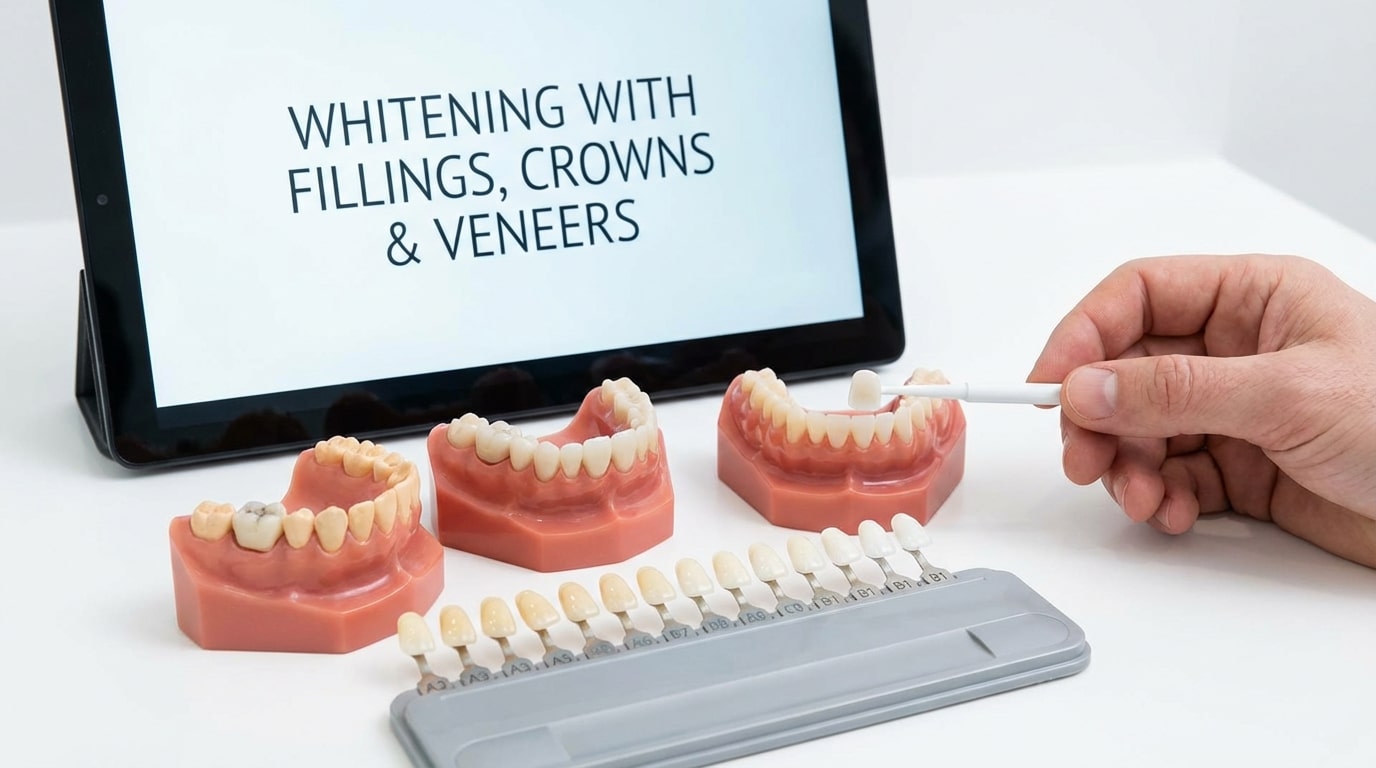
Whitening with Fillings, Crowns & Veneers
Here's a question that catches a lot of people off guard:
"I have fillings on my front teeth. Will they whiten too?"
Short answer: no.
And that can be a problem if you're not prepared for it.
Because while teeth whitening can absolutely transform your natural teeth, it doesn't do a thing for dental restorations like fillings, crowns, veneers, or bonding. They stay exactly the same shade they were when your dentist placed them.
Which means if you whiten your natural teeth without thinking about your existing dental work, you could end up with a mismatched smile. Bright white teeth next to a yellowish filling? Not ideal.
But here's the good news. With a bit of planning, you can absolutely whiten your teethandhave everything match beautifully.
Let's talk about how to do it right.
Why Restorations (Fillings, Crowns, Veneers) Behave Differently Than Natural Teeth
Your natural teeth are porous. They have tiny tubules that allow whitening agents to penetrate and break down stain molecules from within.
Dental restorations, on the other hand, are made from materials like composite resin, porcelain, ceramic, or metal. These materials are non-porous and chemically inert. They don't absorb whitening gel. They don't react to hydrogen peroxide.
They just sit there, unchanged.
So when you whiten your teeth, only your natural enamel and dentin get lighter. Your fillings, crowns, and veneers stay the exact same colour they've always been.
This is super important to know before you start whitening. Because once you whiten your natural teeth, there's no going back. If your restorations no longer match, you'll need to replace them to get a uniform smile.
What Does and Doesn't Change Colour with Whitening
Let's break it down:
What Does Whiten:
Natural tooth enamel
Natural dentin (the layer underneath the enamel)
Surface stains on natural teeth
What Doesn't Whiten:
Composite fillings (white fillings)
Porcelain or ceramic crowns
Porcelain or composite veneers
Dental bonding
Metal crowns (obviously, they're already metal-coloured)
Old amalgam (silver) fillings
So if you have any of these restorations on your front teeth (or anywhere visible when you smile), you need to plan accordingly.
Common Mismatch Scenarios
Here are the situations people run into most often:
Scenario 1: Old Yellow Filling in a Whiter Smile
You had a filling done years ago when your teeth were a bit yellower. Now you've whitened your natural teeth, and suddenly that old filling stands out like a sore thumb. It looks darker, duller, and obvious.
Scenario 2: Dark Crown That No Longer Matches
You got a crown 10 years ago. It was colour-matched to your teeth at the time. But now you've whitened, and the crown looks noticeably darker than the teeth around it.
Scenario 3: Multiple Fillings on Front Teeth
You have several composite fillings on your front teeth. You whiten, and now your smile looks patchy. Some teeth are white, others are still the old shade.
Scenario 4: Bonding That Was Perfect, Now Isn't
You had cosmetic bonding to fix a chipped tooth. It blended perfectly. Then you whitened, and now the bonding looks off-colour compared to the rest of your smile.
These aren't dealbreakers. They're just things you need to plan for.
How to Plan Whitening If You Already Have Front Fillings, Crowns, or Veneers
If you already have visible dental work, here's how to approach whitening:
Step 1: Book a Consultation
Talk to your dentist. Show them where your restorations are and explain that you want to whiten. They'll assess whether the restorations will need to be replaced afterward.
Step 2: Decide If Replacement Is Worth It
If you only have one small filling, replacing it after whitening is no big deal. If you have multiple crowns or veneers, the cost and effort might be significant. You'll need to weigh whether it's worth it.
Step 3: Whiten First, Replace Second
If you decide to move forward, you whiten your natural teeth first. Once they've reached your desired shade and stabilised (usually after a week or two), your dentist can replace the restorations to match the new, brighter colour.
Step 4: Don't Skip the Stabilisation Period
Your teeth will be slightly lighter right after whitening, then settle into a stable shade after a few days. If you replace restorations too soon, they might not match perfectly once your teeth stabilise.
This sequence is critical. If you replace the restorations before whitening, you'll just end up with the same mismatch problem in reverse.
The Ideal Sequence: Whitening First, Then Cosmetic Work to Match
Let's say you're planning some cosmetic dental work and you also want whiter teeth. Here's the smart way to do it:
Whiten your teeth first.Get them to the shade you want.
Wait a week or two for the colour to stabilise.
Then get your crowns, veneers, or fillings done in a shade that matches your newly whitened teeth.
This way, everything is colour-matched to your brightest, whitest smile from day one.
If you do it the other way around (cosmetic work first, whitening later), you'll either have to live with a mismatch or pay to redo the cosmetic work.
So if you're investing in a smile makeover, plan the sequence carefully. Your dentist should guide you through this, but it's good to know the logic yourself.
Options If Your Existing Dental Work No Longer Matches
Okay, so you've already whitened and now your old fillings or crowns don't match. What can you do?
Option 1: Replace the Restorations
This is the cleanest solution. Your dentist removes the old filling or crown and replaces it with a new one in a shade that matches your whitened teeth.
For fillings, this is usually quick and straightforward. For crowns or veneers, it's more involved (and more expensive), but it gives you a perfectly uniform smile.
Option 2: Refinish or Polish the Restoration
In some cases, surface stains on composite fillings or bonding can be polished off. This won't change the underlying colour, but it can help the restoration blend in a bit better.
Option 3: Accept the Mismatch (If It's Minor)
If the mismatch is subtle and only visible up close, you might decide it's not worth replacing. This is a personal call. Some people don't mind. Others can't unsee it.
Option 4: Reverse Your Whitening (Rare)
Technically, your teeth will gradually darken again over time if you go back to drinking coffee, tea, or wine. But this isn't a great solution. It's better to move forward with a plan than to backtrack.
The best option depends on how visible the mismatch is, how much it bothers you, and your budget.
Special Cases: Bonding, Composite Veneers, Internal Bleaching of a Single Dark Tooth
Bonding
Bonding is a composite resin applied to the surface of a tooth to fix chips, gaps, or discolouration. It won't whiten. If you have bonding on a front tooth and you whiten the rest of your teeth, the bonded area will stand out.
The fix? Replace the bonding after whitening. Fortunately, bonding is one of the easier restorations to redo.
Composite Veneers
These are thin layers of composite resin covering the front of your teeth. Like bonding, they don't whiten. If you have composite veneers and you want a brighter smile, you'll need to have the veneers replaced in a lighter shade.
Porcelain veneers are the same deal, they don't whiten either.
Internal Bleaching for a Single Dark Tooth
Sometimes, one tooth is significantly darker than the others. This can happen after a root canal, trauma, or internal staining.
In these cases, your dentist might suggest internal bleaching (also called "walking bleach"). They apply whitening gel inside the tooth and seal it for a few days. The tooth lightens from the inside out.
This can be done alongside or after external whitening of your other teeth to get everything to match.
It's a neat solution for a tricky problem.
Before-and-After Style Scenario Descriptions to Set Expectations
Let's paint a picture of what to expect in different situations:
Scenario A: Small Front Filling, Professional Whitening
Before:You have one small composite filling on a front tooth. It's colour-matched to your natural teeth, which are a shade of light yellow.
After Whitening:Your natural teeth are now several shades whiter. The filling, which used to blend in, now looks slightly darker and more noticeable.
Solution:Your dentist replaces the filling with a new one in a brighter shade. Total cost: $150–$300. Your smile is now uniformly white.
Scenario B: Two Front Crowns, In-Chair Whitening
Before:You have crowns on your two front teeth. They were matched to your teeth 5 years ago. Now you want to whiten.
After Whitening:Your natural teeth are noticeably whiter. The crowns look dull and yellowish by comparison.
Solution:You replace the crowns with new ones in a lighter shade. Total cost: $2,000–$4,000 (depending on the material). It's an investment, but your smile looks flawless.
Scenario C: No Dental Work, Just Natural Teeth
Before:All of your teeth are natural. No fillings, no crowns, no veneers.
After Whitening:Your entire smile is evenly whitened. No mismatches. No complications.
Solution:None needed. This is the easiest scenario.
The takeaway? If you have visible dental work, factor in the potential cost and planning. If your teeth are all natural, you're in the clear.
Who Should Definitely Have a Dentist Assessment Before Whitening
You should absolutely see a dentist before whitening if you have:
Multiple fillings, crowns, or veneers on your front teeth. You need to know if they'll need replacing and plan accordingly.
Old dental work from years ago. It may no longer be in great shape, and whitening could highlight cracks, chips, or discolouration.
A history of trauma to your teeth.Internal staining or damage might need special treatment.
Existing cosmetic work you're happy with. Make sure whitening won't mess up the balance.
Any dental pain, sensitivity, or visible damage. These need to be addressed before whitening.
No surprises. Just a solid plan.
FAQ:
Will my veneers whiten?
No. Veneers (porcelain or composite) don't respond to whitening treatments. They'll stay the same colour they were when they were placed.
Will my filling look obvious after whitening?
It might. If the filling is on a front tooth and it's older or a bit darker, it could stand out once your natural teeth are whiter. The good news is, fillings are easy to replace.
Can I whiten if I have a crown?
Yes, but the crown won't change colour. If it's visible when you smile, you'll need to decide if you're okay with a mismatch or if you want to replace it afterward.
How much does it cost to replace a filling after whitening?
Usually $150 to $300 per filling, depending on the size and location.
What if I have multiple crowns on my front teeth?
Then whitening might not be the best option unless you're prepared to replace the crowns. Talk to your dentist about whether veneers or other cosmetic options make more sense.
Makes sense, right?
The Bottom Line
Whitening your teeth when you have fillings, crowns, or veneers isn't a dealbreaker. It just requires a bit of planning.
The golden rule: whiten first, then replace restorations to match.
If you do it that way, you'll end up with a beautifully uniform, bright smile that looks natural and polished.
If you do it backward (or don't plan at all), you'll end up with mismatched shades and the hassle of fixing them later.
If you're in Sydney and you're not sure how your dental work will affect your whitening, book a consultation with Teeth Whitening Sydney. They'll assess your smile, walk you through your options, and create a plan that gets you the results you want without any surprises.
Because at the end of the day, whitening should make your smile better, not more complicated.
And now? You know exactly how to make that happen.